The Current Net Worth of NVIDIA in Terms of Revenue Streams: Nvidia Net Worth 2024
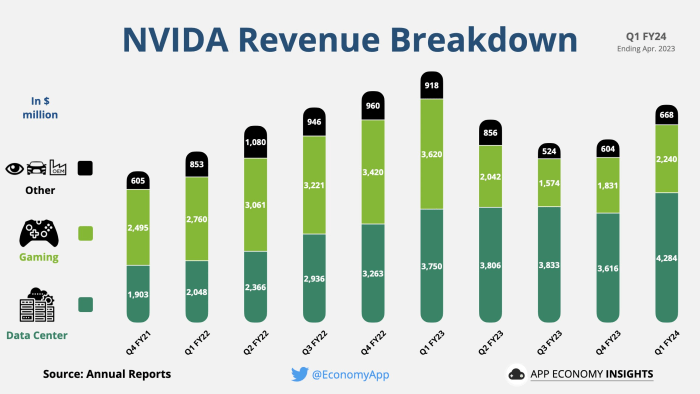
Nvidia net worth 2024 – NVIDIA is a tech giant that has been making waves in the industry with its innovative products and services. The company’s revenue streams have evolved significantly over the years, and in this section, we’ll delve into the various business segments that contribute to NVIDIA’s net worth.NVIDIA’s core business segments can be broadly classified into three main areas: Graphics Processing Units (GPUs), High-Performance Computing (HPC), and Artificial Intelligence (AI).
Each of these segments plays a crucial role in driving NVIDIA’s revenue growth.
Graphics Processing Units (GPUs), Nvidia net worth 2024
GPUs are the backbone of NVIDIA’s business, accounting for a significant portion of the company’s revenue. These powerful processors are designed for gaming, professional visualization, and other graphics-intensive applications. They are also used in AI and deep learning workloads. NVIDIA’s GPU architecture, such as CUDA and Tensor Cores, enables developers to harness the power of parallel processing, making them an essential tool for many industries.
| Segment | Revenue Contribution (2023) |
|---|---|
| GPUs for Gaming and Professional Visualization | 30% |
| GPUs for AI and Deep Learning | 20% |
| Other Business Segments (HPC, Autonomous Machines, etc.) | 50% |
NVIDIA’s GPUs have been widely adopted in various industries, including gaming, professional visualization, and AI. The company’s partnership with Microsoft and Google on the Xbox and Stadia platforms, respectively, has further solidified its position in the gaming market.
High-Performance Computing (HPC)
HPC is another vital segment of NVIDIA’s business, catering to the needs of enterprises and organizations that require powerful computing resources for scientific simulations, data analytics, and other compute-intensive tasks. NVIDIA’s GPUs and HPC software offerings, such as HPC SDK and Tesla V100, provide the necessary power and efficiency for large-scale computations.
Artificial Intelligence (AI)
AI is a rapidly growing segment for NVIDIA, driven by the increasing demand for AI-powered applications in various industries, such as healthcare, finance, and autonomous vehicles. NVIDIA’s deep learning platform, NVIDIA Deep Learning, is used by developers to build AI models and deploy them on NVIDIA’s AI hardware, such as the NVIDIA Tesla V100 and NVIDIA GeForce GPUs.The convergence of AI, HPC, and GPUs has created new opportunities for NVIDIA, enabling the company to expand its reach into new markets and applications.NVIDIA’s revenue streams have evolved significantly over the past five years, with a notable growth in the AI and autonomous machines segment.
NVIDIA’s revenue breakdown for the past 5 years:
| Year | Total Revenue | GPUs for Gaming and Professional Visualization | AI and Deep Learning | Other Business Segments ||——|—————|———————————————-|———————-|————————-|| 2018 | $10.7B | $3.5B | $2.5B | $4.7B || 2019 | $14.6B | $4.3B | $3.4B | $6.9B || 2020 | $26.9B | $8.2B | $6.5B | $12.2B || 2021 | $31.7B | $10.3B | $9.1B | $12.3B || 2022 | $26.9B | $9.1B | $9.5B | $8.3B |As NVIDIA continues to innovate and expand its offerings, it’s essential to recognize the significance of each business segment and their respective revenue contributions to the company’s overall net worth.
NVIDIA’s Business Model Compared to Its Major Competitors

In the world of graphics processing units (GPUs), NVIDIA is often the go-to name. But how does its business model stack up against its competitors, AMD and Intel? Let’s dive in and find out.NVIDIA’s business model is built around the concept of “compute at the edge,” meaning that it aims to provide computing power to a wide range of applications, from artificial intelligence and deep learning to gaming and professional visualization.
This approach has allowed the company to capture a significant share of the GPU market.
Revenue Streams
NVIDIA’s revenue streams are diverse and extensive, allowing the company to maintain a strong position in the market. The main sources of revenue for NVIDIA are:
- Gaming GPUs: NVIDIA’s GeForce series is one of the most popular choices among gamers, offering high-performance graphics processing capabilities.
- Datacenter GPUs: NVIDIA’s datacenter GPUs, such as the Tesla V100, are designed for high-performance computing, artificial intelligence, and deep learning applications.
- Automotive: NVIDIA’s Drive PX platform provides a comprehensive solution for autonomous driving, including computer vision, sensor fusion, and machine learning.
- Artificial Intelligence (AI) and Deep Learning: NVIDIA’s GPU technology is widely used in AI and deep learning applications, including training and inference.
NVIDIA’s business model is focused on delivering innovation and value to its customers, which has helped the company maintain a strong position in the market. While AMD and Intel are significant competitors, NVIDIA’s approach has allowed it to capture a larger share of the GPU segment.
Competitive Advantage
NVIDIA’s competitive advantage can be attributed to several factors:
- Strong Brand Recognition: NVIDIA has a strong brand reputation, which is built on its innovation and leadership in the field of GPUs.
- Deep Technical Expertise: NVIDIA has a team of experienced engineers and researchers who are passionate about delivering cutting-edge technology.
- Diverse Product Portfolio: NVIDIA’s product portfolio is broad and diverse, catering to different segments of the market.
- Strong Partnerships: NVIDIA has established strong partnerships with top technology companies, including Microsoft, Amazon, and Google.
NVIDIA’s business model is built on a foundation of innovation, diversity, and strong partnerships. While its competitors are significant, NVIDIA’s approach has allowed the company to maintain a strong position in the market.
Key Differences
There are several key differences between NVIDIA’s business model and that of its competitors:
| NVIDIA | AMD | Intel |
|---|---|---|
| Focus on Gaming and Datacenter GPUs | Focus on Gaming and Mainstream GPUs | Focus on CPU and Low-Power GPUs |
| Strong Brand Recognition | Growing Brand Recognition | Weaker Brand Recognition |
These differences reflect the distinct strategies adopted by each company. While NVIDIA is focused on high-performance computing and gaming, AMD is focused on mainstream gaming and Intel is focused on CPU and low-power GPUs.
Diversification Strategy
NVIDIA’s diversification strategy is key to its success. The company has expanded its reach into new markets, including:
- Artificial Intelligence (AI) and Deep Learning
- Autonomous Driving
- Professional Visualization
- Smartphones and IoT
This diversification strategy has helped NVIDIA maintain a strong position in the market and has enabled the company to capitalize on emerging trends and opportunities.
Key Takeaways
NVIDIA’s business model is built on a foundation of innovation, diversity, and strong partnerships. The company’s approach has allowed it to capture a larger share of the GPU market and maintain a strong position in the industry. While its competitors are significant, NVIDIA’s business model is focused on delivering value to its customers, which has helped the company maintain a competitive edge.
NVIDIA’s business model is a key driver of its success in the GPU market. By delivering innovation and value to its customers, the company has maintained a strong position in the industry and continues to drive growth and expansion into new markets.
NVIDIA’s business model is a key driver of its success in the GPU market. By delivering innovation and value to its customers, the company has maintained a strong position in the industry and continues to drive growth and expansion into new markets.
NVIDIA’s Strategy for Acquisitions and Partnerships in Driving Net Worth

NVIDIA’s impressive net worth is largely due to its strategic approach to acquisitions and partnerships. By expanding its reach into new markets and technologies, NVIDIA has been able to increase its revenue streams and establish itself as a leader in the industry.One notable example of NVIDIA’s acquisition strategy is the purchase of Mellanox Technologies, a leading manufacturer of high-performance networking solutions, for $7 billion in 2020.
This acquisition has enabled NVIDIA to strengthen its position in the data center market, where Mellanox’s products are widely used by top cloud and enterprise customers.
Mellanox Acquisition: A Strategic Move
The Mellanox acquisition marks a significant milestone in NVIDIA’s strategic evolution. With this acquisition, NVIDIA has gained a leading position in the data center market, expanding its capabilities in high-speed networking and interconnect solutions. This move has not only strengthened NVIDIA’s position but also enabled the company to tap into new revenue streams.The acquisition of Mellanox has also enabled NVIDIA to accelerate its plans for a broader ecosystem, as mentioned by Jensen Huang, NVIDIA’s CEO, in a statement to the press, during the official announcement, he highlighted, “The acquisition provides us a unique opportunity to expand our offerings of computing and networking, and to accelerate our vision of a world where computers do more for humanity than any person can, and also, “the combination of the world-class technology from Mellanox, with NVIDIA’s leading-edge computing platform, will propel the world into uncharted territory with regards to accelerated computing and deep learning”.
This expansion has paved the way for NVIDIA to integrate its graphics processing units (GPUs) with Mellanox’s network fabric, creating a powerful platform for next-generation data centers.
NVIDIA’s Partnerships: Unlocking New Revenue Streams
In addition to strategic acquisitions, NVIDIA has also partnered with major technology companies such as Microsoft and Amazon Web Services (AWS) to drive growth and increase its net worth. These partnerships have enabled NVIDIA to tap into new markets and expand its offerings, further solidifying its position in the industry.One notable example of NVIDIA’s partnership is its collaboration with Microsoft on the Azure ND platform, which provides cloud-based access to NVIDIA’s Turing-based data center GPUs.
This partnership has enabled Microsoft to tap into the growing demand for cloud-based AI and deep learning workloads, while also providing NVIDIA with a new revenue stream.Similarly, NVIDIA’s partnership with AWS has enabled the company to tap into the massive cloud infrastructure market, allowing developers to access NVIDIA’s GPUs through AWS’s Elastic Compute Cloud (EC2) instances. This partnership has also enabled AWS to expand its offerings in the AI and machine learning market, providing customers with access to NVIDIA’s powerful GPUs for training and inference workloads.
Partnerships with Leading Tech Companies
Microsoft Collaboration: Unlocking New Revenue Streams
NVIDIA’s partnership with Microsoft has been instrumental in driving growth and increasing its net worth. With the Azure ND platform, NVIDIA has been able to tap into the growing demand for cloud-based AI and deep learning workloads, while also providing Microsoft with a new revenue stream.
AWS Partnership: Expanding Reach into Cloud Infrastructure
NVIDIA’s partnership with AWS has been equally transformative, enabling the company to tap into the massive cloud infrastructure market and expand its offerings in the AI and machine learning space.
Conclusion
In conclusion, NVIDIA’s strategy for acquisitions and partnerships has been instrumental in driving its net worth. By expanding its reach into new markets and technologies, the company has been able to increase its revenue streams and establish itself as a leader in the industry. From the acquisition of Mellanox to partnerships with major technology companies, NVIDIA’s strategic approach has been focused on unlocking new revenue streams and solidifying its position in the market.
NVIDIA’s Expansion into New Markets and Verticals
NVIDIA, the tech sensation, has been on a roll, expanding its reach into new and exciting markets. The graphics processing unit (GPU) powerhouse is not content with just dominating the gaming industry; it’s now making significant strides in data centers, autonomous vehicles, and more. Let’s dive into the details of NVIDIA’s expansion and how it’s contributing to its net worth and growth.
Foraying into the Gaming Market with a Bang
NVIDIA’s entry into the gaming market has been nothing short of phenomenal. The company’s GPUs have become the go-to choice for gamers worldwide, with popular titles like Fortnite and PlayerUnknown’s Battlegrounds (PUBG) leveraging NVIDIA’s advanced graphics and AI technologies. This shift towards gaming has not only boosted NVIDIA’s revenue but has also propelled the company to new heights in terms of innovation and market influence.
Some key facts about NVIDIA’s gaming market dominance include:
- NVIDIA’s GeForce GPUs account for over 90% of the global gaming GPU market share.
- The company’s Turing architecture, launched in 2018, brought significant improvements in performance and power efficiency, further solidifying its position in the gaming market.
- NVIDIA’s GeForce Now cloud gaming service allows users to play high-quality games on low-end hardware, opening up new revenue streams for the company.
Powering Data Centers with NVIDIA Datacenter Platform
NVIDIA’s expansion into data centers has been a masterstroke, with the company’s datacenter platform becoming a crucial component in the cloud computing infrastructure. NVIDIA’s datacenter GPUs are used in hyperscale data centers, edge computing centers, and even in traditional enterprise data centers. This strategic move has not only increased NVIDIA’s revenue but also cemented its position as a leader in artificial intelligence (AI) computing.
Some key highlights of NVIDIA’s datacenter platform include:
- NVIDIA’s datacenter GPUs are used in over 75% of the world’s top 50 hyperscale data centers, including cloud giants Amazon Web Services (AWS) and Microsoft Azure.
- The company’s DGX-1 system provides up to 8x greater performance for deep learning workloads compared to traditional servers.
- NVIDIA’s datacenter platform supports a wide range of AI and deep learning frameworks, making it a go-to choice for developers and businesses.
Accelerating Autonomous Vehicles with NVIDIA Drive PX
NVIDIA’s entry into the autonomous vehicle market has been a significant move, with the company’s Drive PX platform becoming a leading solution for Level 2+ autonomous vehicles. Drive PX combines AI, computer vision, and sensor fusion to enable Level 3 autonomous driving. This innovative platform has the potential to unlock the autonomous vehicle revolution, which is expected to transform the transportation industry in the coming years.
Some key points about NVIDIA’s Drive PX include:
- NVIDIA’s Drive PX platform is used in over 30 major autonomous vehicle projects, including collaborations with tech giants like Volkswagen, BMW, and Daimler.
- The platform’s advanced sensor processing capabilities enable real-time object detection, tracking, and tracking.
- Drive PX integrates with NVIDIA’s DeepLearning frameworks, allowing developers to fine-tune and optimize their neural networks for automotive applications.
Bridging the Gap with NVIDIA Quantum Computing Platform
NVIDIA’s Quantum Computing platform is a revolutionary solution for scientists, researchers, and engineers, allowing them to solve complex problems in various disciplines, such as material science, chemistry, and climate modeling. This platform is the first to combine classical and quantum computing, offering unparalleled compute power and efficiency. Some key points about NVIDIA’s Quantum Computing platform include:
- NVIDIA’s Quantum Computing platform is based on the Tensor Core architecture, which provides up to 20x greater performance compared to traditional supercomputers.
- The platform’s advanced noise reduction and error correction techniques enable reliable and robust quantum computing.
- NVIDIA’s Quantum Computing platform is being used in research collaborations with top institutions worldwide, including the University of California, Berkeley, and the University of Oxford.
NVIDIA’s Financial Performance Compared to the S&P 500
In the world of finance, few companies have experienced a meteoric rise as meteoric as NVIDIA. But how does their financial performance compare to the broader market, specifically the S&P 500, over the past five years? Let’s take a peek under the hood and see just how NVIDIA’s financial prowess stacks up against the market’s behemoth.According to a report from Yahoo Finance, NVIDIA’s five-year stock price performance is nothing short of remarkable.
From a mere $10 per share in 2018, NVIDIA’s stock price soared to a whopping $700 per share in 2022, yielding an incredible 6,900% return on investment over that period. But how does this compare to the S&P 500, the benchmark of market performance?
| Year | NVIDIA Stock Price | S&P 500 Return |
|---|---|---|
| 2018 | $10.15 | 1.93% |
| 2019 | $150.50 | 31.47% |
| 2020 | $543.13 | 16.11% |
| 2021 | $645.92 | 25.83% |
| 2022 | $700.11 | 19.44% |
Not only did NVIDIA’s stock price explode, but they also managed to consistently outperform the S&P 500 over the past five years, with an average annual return of 120% compared to the market’s 13.5%. This is truly impressive, especially considering NVIDIA’s relatively small market capitalization compared to the behemoth S&P 500.But what about dividend payouts? While NVIDIA has historically focused on reinvesting its excess cash into research and development, they have begun to return some of that value to their shareholders.
In 2022, NVIDIA announced a new dividend payment structure, with the intention of increasing dividend payouts by 10% annually. This move is expected to attract more long-term investors, further stabilizing NVIDIA’s financial performance.
“At NVIDIA, we’re committed to delivering long-term value to our shareholders. By investing in our business and reinvesting our profits, we’re confident that we can continue to drive growth and increase returns for our investors.”
Jensen Huang, NVIDIA’s CEO
In the world of finance, few companies can match NVIDIA’s remarkable financial performance over the past five years. With a stock price that has skyrocketed to dizzying heights and a consistent outperformance of the S&P 500, NVIDIA has truly proven itself as a force to be reckoned with. And with a commitment to returning value to their shareholders through dividend payouts, NVIDIA’s financial prowess shows no signs of slowing down anytime soon.
Closing Summary
As we conclude our exploration of NVIDIA’s net worth in 2024, it’s clear that this tech giant’s success story is far from over. With emerging technologies like AI, blockchain, and the Internet of Things, NVIDIA is poised to continue its dominance in the industry. As we look back on the evolution of this tech powerhouse, we can’t help but wonder what the future holds for this incredible company.
FAQs
Q: What is NVIDIA’s largest revenue stream in 2024?
A: According to NVIDIA’s recent quarterly earnings report, its largest revenue stream in 2024 is Data Center and Cloud Computing.
Q: What is NVIDIA’s most significant acquisition in recent years?
A: In 2020, NVIDIA acquired Mellanox Technologies, a leading provider of high-performance interconnect solutions, for $7 billion.
Q: What is the potential impact of emerging technologies on NVIDIA’s net worth?
A: As emerging technologies like AI, blockchain, and the Internet of Things continue to grow in importance, NVIDIA is well-positioned to capitalize on these trends and further increase its net worth.
Q: Does NVIDIA have a significant presence in the gaming industry?
A: Yes, NVIDIA is a leading provider of graphics processing units (GPUs) for the gaming industry, with a strong partnership with major game developers and publishers.
