Notable British Philanthropists and Their Endowments
British net worth – As the land of tea, royalty, and iconic red phone booths, Britain is also home to a plethora of kind-hearted individuals who’ve dedicated their wealth and time to making a positive impact on society. These British philanthropists are a testament to the generosity and compassion of the human spirit, and their contributions have left an indelible mark on the world.
John Paul Getty’s Philanthropic Efforts
- The late John Paul Getty, the billionaire oil tycoon, left behind a legacy that extends far beyond his business empire. He donated a significant portion of his wealth to various charitable causes, including the establishment of the Getty Museum in Los Angeles and the restoration of the Roman Forum in Italy. Getty’s philanthropic efforts not only showcased his commitment to art and culture but also demonstrated the lasting impact of his generosity.
- Getty’s charitable endeavors were not limited to his personal interests, however; he also supported a wide range of causes, from education and healthcare to the preservation of historical landmarks.
- Getty’s philanthropy has inspired countless others to follow in his footsteps, proving that giving back to society can have a lasting and far-reaching impact.
The British Empire of Charles Keating
- In the early 2000s, Charles Keating, the billionaire businessman behind the failed Bank of Credit and Commerce International (BCCI), made headlines for his audacious philanthropy. Keating donated an astonishing £60 million to various British charities, including the Royal National Society for the Prevention of Cruelty to Children and the British Red Cross.
- Keating’s philanthropic efforts were not without controversy, however. Critics pointed out that the donations were likely a strategic move to repair his tattered public image following the bankruptcy of BCCI.
- Regardless of the motivations behind Keating’s generosity, his philanthropic endeavors undoubtedly made a tangible difference in the lives of countless Brits.
The Enduring Legacy of Andrew Carnegie, British net worth
- Andrew Carnegie, the Scottish-American industrialist, was a pioneer of philanthropy in the late 19th and early 20th centuries. Through his philanthropic efforts, Carnegie gifted away over $350 million to various causes, including education, science, and world peace.
- Carnegie’s donations not only supported the establishment of over 2,500 libraries across the United States and Britain but also fostered a culture of lifelong learning and intellectual exploration.
- Today, the Carnegie Foundation continues to award grants to worthy causes around the world, ensuring that Carnegie’s vision for a more enlightened and compassionate society remains alive and well.
Sir Tom Hunter’s Vision for a Brighter Future
- Sir Tom Hunter, the Scottish entrepreneur behind the Sports Holdings retail company, has been a vocal advocate for philanthropy and social responsibility throughout his career.
- Through the Trusting Foundation, Hunter has donated millions to various causes, including education, healthcare, and community development programs.
- Hunter’s philanthropic efforts have earned him numerous accolades, including a knighthood for his services to business and philanthropy.
The Philanthropic Vision of The Duke of Westminster
- William Cavendish-Bentham, 6th Duke of Westminster, left a lasting impact on British society through his philanthropic endeavors.
- The Duke’s charitable efforts included the establishment of the Westminster Foundation, which supports various causes around the world, from education and healthcare to environmental conservation.
- The Duke’s philanthropy has been recognized through numerous awards and accolades, cementing his legacy as a dedicated philanthropist and champion of social justice.
A Historical Perspective on British Trade and Commerce
The United Kingdom’s economic supremacy has been a topic of interest for centuries, with trade and commerce playing a pivotal role in its evolution. As the sun never set on the British Empire, its merchants and traders sailed the world, exploring uncharted territories, and establishing colonies that would serve as stepping stones for the country’s economic growth. This era saw the emergence of powerful British trade companies, which would shape the course of world history.The East India Company, established in 1600, was one of the most influential of these trade companies.
Initially, its primary objective was to trade in spices and textiles with the Far East. However, over time, it expanded its activities, controlling a vast portion of India’s economy and influencing its politics. The company’s dominance was so profound that it has been dubbed the “Mother of Parliaments” for its role in shaping the parliamentary system of governance in India.The British East India Company’s success was driven by its well-organized network of merchants, traders, and administrators who traveled extensively across the globe, establishing new trade routes and exploiting existing ones.
The company’s innovative approach to commerce included the use of advanced accounting systems, the creation of a complex network of alliances with local governments, and its mastery of the art of taxation.The company’s growth had a profound impact on British trade and commerce. It helped establish Britain as a major economic power, creating a vast network of trade routes that connected Europe, Asia, and Africa.
This expansion fueled Britain’s industrial revolution, as the country transitioned from an agrarian economy to a manufacturing-based one. The development of new technologies, such as the steam engine and the textile machine, further accelerated Britain’s economic growth, solidifying its position as a leading industrial nation.The East India Company’s influence on British culture was equally significant. The company’s merchants and traders brought back exotic goods, such as spices, textiles, and precious stones, which became highly sought after in Britain.
This cultural exchange helped shape British tastes, influencing the development of art, literature, and music.As Britain’s industrial revolution took hold, the country’s trade and commerce continued to grow. The establishment of the British Board of Trade in 1649 marked a significant turning point in British trade policy, as the government began to actively promote trade and commerce. The Board of Trade facilitated the creation of new trade agreements, the expansion of trade routes, and the development of new industries.The growth of international trade had a profound impact on British culture, influencing the development of art, literature, and music.
The country’s merchants and traders brought back exotic goods, such as spices, textiles, and precious stones, which became highly sought after in Britain. This cultural exchange helped shape British tastes, as the country’s elite eagerly adopted new customs and fashions.The development of global trade networks also played a significant role in shaping British culture. The country’s merchants and traders established trade relationships with other nations, sharing goods, ideas, and technologies.
This cultural exchange helped spread British values and customs, as well as adopting foreign influences.The growth of international trade had a profound impact on Britain’s economic development. The country’s merchants and traders established trade relationships with other nations, sharing goods, ideas, and technologies. This cultural exchange helped spread British values and customs, as well as adopting foreign influences. The country’s industrial revolution was further accelerated by the growth of international trade, as new technologies and industries emerged.
The British Board of Trade and its Impact on Trade Policy
The British Board of Trade played a crucial role in shaping trade policy, as the government actively promoted trade and commerce. The Board of Trade facilitated the creation of new trade agreements, the expansion of trade routes, and the development of new industries. This had a profound impact on Britain’s economic development, as the country transitioned from an agrarian economy to a manufacturing-based one.
The East India Company’s Impact on British Culture
The East India Company’s impact on British culture was significant. The company’s merchants and traders brought back exotic goods, such as spices, textiles, and precious stones, which became highly sought after in Britain. This cultural exchange helped shape British tastes, as the country’s elite eagerly adopted new customs and fashions. The company’s influence on British culture was further reinforced by its control of India’s economy and its role in shaping the country’s politics.
The Growth of International Trade and its Impact on British Culture
The growth of international trade had a profound impact on British culture, influencing the development of art, literature, and music. The country’s merchants and traders established trade relationships with other nations, sharing goods, ideas, and technologies. This cultural exchange helped spread British values and customs, as well as adopting foreign influences.
British Entrepreneurs and Their Contributions to National Wealth
Britain, a nation renowned for its rich entrepreneurial history, has given birth to some of the world’s most iconic and successful businesses. From the humble beginnings of a small shop to the global domination of a blue-chip brand, British entrepreneurs have consistently pushed the boundaries of innovation and commerce. These trailblazers have not only revolutionized the business landscape but have also contributed significantly to the nation’s wealth and prosperity.These entrepreneurs, often dubbed the ‘makers of Britain’, have been instrumental in shaping the country’s economic landscape.
Their contributions range from creating jobs and stimulating growth to paving the way for future generations of entrepreneurs. As the nation’s economy continues to evolve, their impact will be felt for generations to come.
The Birth of Global Brands
Take, for instance, the story of Richard Marks and Charles Clore, the founders of Next, the iconic high-street retailer. With a mere £1,000 in investments, they turned a small store in Northampton into a global fashion powerhouse, employing over 40,000 people and generating annual revenues exceeding £4 billion. Their vision and risk-taking nature are testaments to the entrepreneurial spirit that has defined British business history.Similarly, the founders of ASOS, Nick Robertson and Quentin Griffiths, transformed a small online retailer into a global fashion giant, with annual revenues now exceeding £3 billion and a presence in over 220 countries.
Their entrepreneurial drive and willingness to take calculated risks have enabled ASOS to stay ahead of the curve in an ever-evolving digital landscape.The key factors that have contributed to the success of these entrepreneurs include an insatiable appetite for innovation, coupled with an unwavering commitment to risk-taking and adaptability. Their ability to identify emerging trends and capitalize on them has been instrumental in driving growth and expansion.
Moreover, their willingness to invest in the development of their employees has enabled them to build a skilled and loyal workforce, crucial for sustained success in an increasingly competitive market.These factors have not only contributed to the success of these businesses but have also had a profound impact on the British economy as a whole. The creation of jobs, stimulation of growth, and contribution to the nation’s wealth are just a few examples of the tangible benefits that these entrepreneurs have brought to the nation.
Driving Innovation and Job Creation
According to a report by the UK’s Confederation of British Industry (CBI), entrepreneurs like those mentioned above have been instrumental in driving innovation and job creation in the UK. The report highlights that since the 2008 financial crisis, entrepreneurs have been responsible for creating over 75% of new jobs in the UK, with small and medium-sized enterprises (SMEs) accounting for over 60% of all employment opportunities created.Moreover, a study by the Centre for Entrepreneurs found that entrepreneurs are not only job creators but also significant contributors to the nation’s GDP.
The study estimates that entrepreneurs are responsible for generating over 25% of the UK’s GDP, with the majority of this growth coming from small and medium-sized enterprises.These statistics are a testament to the significant contribution that entrepreneurs have made to the British economy. Their innovative spirit, commitment to job creation, and willingness to invest in the development of their employees have all played a crucial role in driving growth and expansion.
The Legacy of British Entrepreneurs
As the British economy continues to evolve, the legacy of these entrepreneurs will be felt for generations to come. Their contributions to job creation, innovation, and economic growth will be crucial in shaping the nation’s economic landscape. Moreover, their willingness to take calculated risks and invest in their employees will provide a template for future generations of entrepreneurs, empowering them to build successful businesses that will drive growth and prosperity.In conclusion, the story of British entrepreneurs is one of innovation, risk-taking, and determination.
Their contributions to the nation’s wealth and prosperity will be felt for generations to come, and their legacy will continue to inspire and motivate future generations of entrepreneurs. As the nation’s economy continues to evolve, the impact of these entrepreneurs will only continue to grow, ensuring that Britain remains a beacon of entrepreneurship and innovation.
The Impact of Brexit on British Trade and Commerce

As the UK navigates its exit from the European Union, the effects of Brexit on British trade and commerce are being felt across the nation. With changing tax policies and trade agreements on the horizon, businesses and individuals alike are wondering what the future holds. In this article, we’ll delve into the potential impacts of Brexit on British trade and commerce, examining the possibilities and pitfalls that lie ahead.
Tax Policy Changes
The UK’s departure from the EU has led to concerns about tax policy changes. One of the most significant changes is the potential introduction of a digital services tax (DST). The DST would target large digital companies, such as Google and Amazon, and could bring in much-needed revenue for the UK government. However, this could also lead to a rise in taxes for British businesses, making them less competitive in the global market.As reported by the BBC, the UK government has proposed a DST, which would tax online giants on their UK revenues.
This could raise an estimated £400 million per annum for the British economy. However, critics argue that this could lead to a rise in prices for consumers and hurt small businesses.
- Introduction of a digital services tax (DST)
- Rise in taxes for British businesses
- Potential increase in prices for consumers
Trade Agreements
Brexit has led to a significant shift in trade agreements, with the UK now having to negotiate its own deals with countries around the world. This has created a sense of uncertainty, with many businesses wondering what the new rules will be.One of the key challenges is the potential loss of access to the EU’s single market. As a result, British businesses may face customs checks and tariffs when exporting goods to EU countries.
This could lead to increased costs and logistical nightmares for companies that rely on just-in-time delivery.
According to a report by the Centre for Economic Performance (CEP), a no-deal Brexit could lead to a 10-15% reduction in UK trade with the EU.
- Custs checks and tariffs on EU imports
- Potential loss of access to the EU’s single market
- Increased costs and logistical challenges
Impact on British Net Worth
The outcome of the Brexit negotiations will have a significant impact on British net worth. As a result of the changes in trade agreements and tax policies, businesses and individuals may see their wealth affected in various ways.For example, a rise in taxes could lead to a decrease in the value of investments, while a loss of access to the EU’s single market could hit the value of companies that rely on trade with EU countries.
- Rise in taxes could decrease the value of investments
- Loss of access to the EU’s single market could hit the value of companies reliant on trade with EU countries
- Uncertainty and volatility in financial markets
The Significance of Wealth and Income Inequality in the UK: British Net Worth
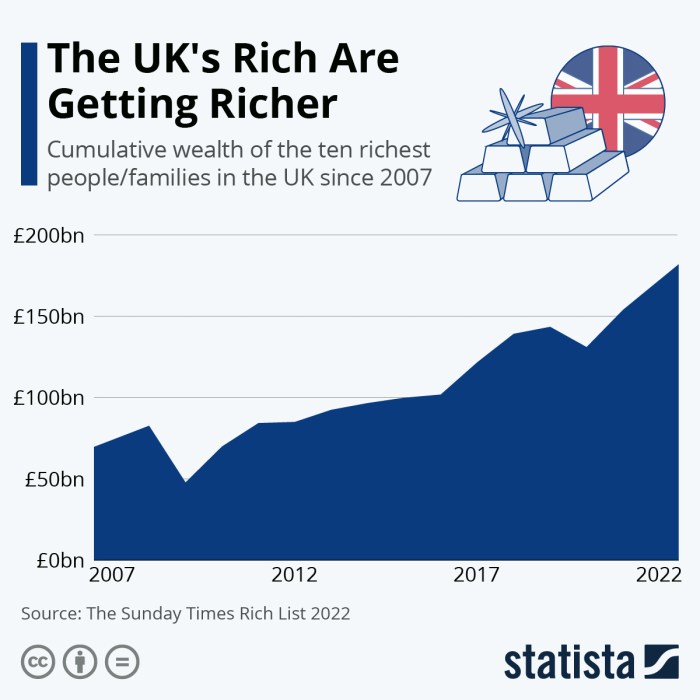
Wealth and income inequality have become a pressing concern in the UK, with far-reaching social implications. While the British economy has experienced significant growth in recent years, the benefits of this growth have not been evenly distributed. As a result, the wealth gap between the rich and the poor has continued to widen, threatening social cohesion and economic stability.The latest data from the Institute for Fiscal Studies shows that the wealthiest 10% of the population now hold over 45% of the country’s total wealth, while the poorest 10% hold less than 1%.
This stark disparity has severe consequences for individuals and society as a whole. Those at the lower end of the income scale often find themselves struggling to make ends meet, with little opportunity to improve their socio-economic circumstances.
Causes of Wealth Inequality
Wealth inequality in the UK is a complex problem with multiple causes. One significant contributor is the inheritance of wealth, which perpetuates existing social and economic disparities. According to a study by the Equality Trust, the UK’s inheritance tax system favors the wealthy, allowing them to pass on large sums of money to their descendants without incurring significant tax liabilities.Another factor is the concentration of wealth among a small elite.
The top 1% of earners in the UK control a disproportionate amount of wealth, with many individuals holding significant stakes in large corporations or real estate. This concentration of wealth can limit opportunities for social mobility and perpetuate inequality.
Measures to Address Wealth Disparities
Several measures can help address wealth disparities and promote economic equality in the UK.### Progressive TaxationA more progressive tax system, where higher earners are taxed at a higher rate, can help reduce wealth inequality. This can be achieved through the introduction of a wealth tax or a higher top marginal tax rate.### Inheritance Tax ReformsReforming the inheritance tax system to impose greater taxes on large inheritances could help reduce the concentration of wealth among the wealthy.
This could involve increasing the threshold for paying inheritance tax or introducing a more progressive rate structure.### Improved Access to Education and Job TrainingProviding better access to education and job training can help individuals from lower-income backgrounds improve their socio-economic circumstances. This can be achieved through increased investment in education and training programs, as well as more flexible apprenticeship schemes.### Affordable Housing InitiativesAddressing the housing affordability crisis is crucial to reducing wealth inequality.
Increasing the supply of affordable housing, implementing rent controls, and introducing more generous subsidies for low-income renters could help make housing more accessible to those on lower incomes.
Economic Consequences of Wealth Inequality
Wealth inequality has severe economic consequences, including reduced economic growth, decreased social mobility, and increased poverty levels. According to a study by the OECD, countries with high levels of wealth inequality tend to experience slower economic growth and reduced productivity.### Reduced Economic GrowthWealth inequality can limit economic growth by reducing consumer spending and investment. When individuals from lower-income backgrounds have less disposable income, they are less likely to spend money on goods and services, which can limit economic growth.### Decreased Social MobilityWealth inequality can also limit social mobility, making it more difficult for individuals to improve their socio-economic circumstances.
When individuals from higher-income backgrounds hold most of the wealth, they are more likely to inherit privileged positions and opportunities, which can limit opportunities for social mobility.
Solutions and Recommendations
To address wealth inequality in the UK, the government can implement more progressive taxation, inheritance tax reforms, and improved access to education and job training. Affordable housing initiatives can also help make housing more accessible to those on lower incomes.Ultimately, reducing wealth inequality requires a comprehensive approach that tackles the root causes of the problem. By implementing policies that promote economic equality and social mobility, the UK can work towards a more inclusive and prosperous society for all.
The Economic Importance of the British Royal Family’s Real Estate Holdings

The British royal family’s real estate holdings are an integral part of the country’s history and culture, with properties spanning across the globe. From Buckingham Palace to the Queen’s private estates, these holdings contribute significantly to the UK’s economy. This section delves into the economic importance of the royal family’s real estate, highlighting their cultural and economic impact.The royal family’s real estate holdings contribute to the UK’s GDP in various ways, including through tourism and property rentals.
Buckingham Palace, for instance, is one of the most visited attractions in London, attracting millions of tourists annually. Visitors pay to see the State Rooms, which are maintained by the royal family’s real estate holdings, generating a significant revenue stream for the UK.
Properties Owned by the British Royal Family
The British royal family owns numerous properties across the UK, each with its own unique history and significance. Some of these properties include:
- Windsor Castle: The oldest and largest inhabited castle in the world, Windsor Castle has been a royal residence for over 900 years. It attracts millions of tourists each year and is a major contributor to the local economy.
- Sandringham House: Located in Norfolk, Sandringham House is the Queen’s private estate and a popular tourist destination. The estate features a stunning church, a museum, and a gift shop, generating significant revenue for the local community.
These properties not only attract tourists but also generate revenue through property rentals and sales. The royal family’s real estate holdings have significant cultural and economic importance, with each property maintaining its own unique identity and history.
Tourism and Job Creation
The royal family’s real estate holdings contribute to the UK’s tourism industry, generating revenue and creating jobs for the local community. Buckingham Palace, for instance, offers tourists the opportunity to see the State Rooms and explore the Queen’s Gallery. The palace also hosts various events, such as the annual Trooping the Colour ceremony, which attracts millions of viewers worldwide.The economic impact of the royal family’s real estate holdings can be seen in the local economies surrounding these properties.
For example:
- Buckingham Palace: The palace generates significant revenue for the local economy, with estimates suggesting that it contributes around £500 million annually to the UK’s GDP.
- Sandringham House: The estate generates revenue for the local community, with around £1 million spent annually on local goods and services.
- Balmoral Castle: The castle attracts tourists, generating significant revenue for the local economy, with estimates suggesting that it contributes around £2 million annually to the local GDP.
Conclusion
The British royal family’s real estate holdings are an integral part of the country’s history and culture. These properties contribute significantly to the UK’s GDP through tourism and property rentals, generating revenue and creating jobs for the local community. The royal family’s real estate holdings have significant cultural and economic importance, with each property maintaining its own unique identity and history.
Closing Notes
As we conclude our exploration of British net worth, it becomes clear that the complex interplay between industry, philanthropy, and the British monarchy has crafted a distinct economic and social identity for the United Kingdom. From its industrial roots to its current status as a global power, the narrative of British net worth serves as a testament to the enduring legacy of British entrepreneurship, innovation, and community spirit.
However, it also raises important questions about the ongoing challenges posed by wealth and income inequality, prompting us to reflect on the critical role that education, policy initiatives, and cultural shifts must play in shaping a more equitable future for all.
Helpful Answers
What is the primary driver of wealth inequality in the UK?
Wealth inequality in the UK is primarily driven by factors such as differences in income, inheritance, and access to education and job opportunities.
How do inheritance taxes impact British net worth?
Inheritance taxes redistribute wealth from the wealthy to the general public, helping to reduce inequality and generate government revenue. However, they can also have unintended consequences, such as reducing the incentive for entrepreneurship and investment.
What are some notable examples of British philanthropy?
Sir Richard Branson’s support for entrepreneurship education, the Gates Foundation’s funding for global health initiatives, and the Prince’s Trust’s work with disadvantaged youth are just a few examples of the significant positive impact that philanthropic efforts can have on British society and beyond.
