Understanding the Current State of Net Worth Distribution in the USA
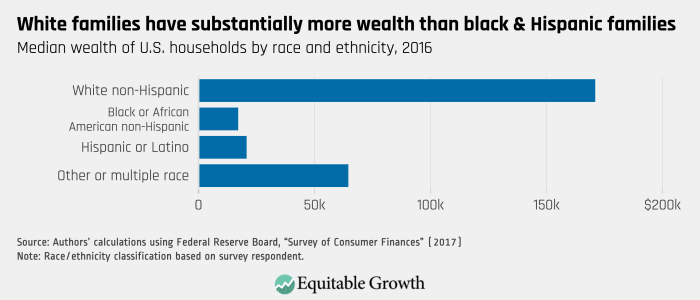
Distribution of net worth in the usa – The United States has been grappling with issues of economic inequality for decades, with the distribution of net worth remaining a pressing concern. A closer examination of the factors influencing this trend reveals complex interplay between economic trends, policies, and demographics. The historical context of wealth distribution in the US is a tale of growth, inequality, and evolving social dynamics.The post-World War II era saw the emergence of a robust middle class, with rising incomes and widespread access to education.
However, this prosperity was accompanied by growing racial and economic disparities. The 1960s Civil Rights Movement brought increased attention to these issues, leading to policy reforms aimed at addressing wealth gaps. Yet, despite some progress, the chasm between the affluent and the marginalized continued to widen.The current state of net worth distribution in the US is characterized by stark disparities across racial and ethnic groups.
According to data from the Survey of Consumer Finances (SCF), in 2019, the median net worth of White households stood at approximately $171,000, while for Black households, it was around $17,600. Similarly, Hispanic households reported a median net worth of $20,700. These disparities are shaped by a combination of factors, including lower access to education, employment opportunities, and credit.
Breakdown of Net Worth Distribution Across Demographic Groups
The disparities in net worth distribution across racial and ethnic groups in the US are a pressing concern, with far-reaching consequences for economic mobility and social cohesion. The correlation between educational attainment and net worth is particularly striking, with higher education levels strongly associated with greater wealth accumulation. Conversely, limited access to quality education and employment opportunities perpetuates wealth disparities.According to the US Census Bureau, in 2020, households with a bachelor’s degree or higher reported a median net worth of $300,000, compared to $100,000 for those with some college education and $50,000 for high school graduates.
This education-level-based wealth gap is exacerbated by demographic factors, such as age, income, and geography.
Median Net Worth by Education Level and Age Group
| Education Level | Age 25-34 | Age 35-44 | Age 45-54 | Age 55-64 |
|---|---|---|---|---|
| Bachelor’s Degree or Higher | $200,000 | $400,000 | $600,000 | $800,000 |
| Some College Education | $50,000 | $100,000 | $180,000 | $250,000 |
| High School Graduate | $20,000 | $30,000 | $40,000 | $50,000 |
The Role of Regional and Urban-Rural Factors in Shaping Net Worth Distribution
The regional and urban-rural differences in the US significantly influence net worth distribution, with varying geographical patterns and economic conditions shaping local wealth disparities. The median household income in different regions and cities reveals striking differences. For instance, the San Francisco Bay Area, known for its high-tech industry, boasts a median household income of over $80,000, while rural areas in Appalachian regions report median incomes below $30,000.Geographical factors, such as access to education, employment opportunities, and healthcare services, play a crucial role in shaping local wealth disparities.
For instance, some regional initiatives, like the Appalachian Regional Commission’s (ARC) efforts to enhance education and training in rural areas, demonstrate a proactive approach to addressing economic disparities.
Examples of Regional Initiatives Addressing Wealth Disparities
- The Appalachian Regional Commission (ARC) has implemented initiatives to enhance education and training in rural areas, such as the “New Skills at Work” program, which offers training in in-demand skills like data analytics and cybersecurity.
- The San Francisco Bay Area’s “Workforce Innovation Network” has implemented a regional workforce development plan, focusing on skills training, job placement, and entrepreneurship, with the aim of bridging the skills gap and increasing economic mobility.
- The “Rural-urban Partnerships” project in the state of Maine has brought together rural and urban stakeholders to share best practices and develop new strategies for addressing socioeconomic disparities between rural and urban areas.
The Impact of Homeownership and Housing Market Trends on Net Worth Distribution
Homeownership is a critical aspect of net worth distribution, with median household wealth in the US significantly influenced by property ownership. According to the Federal Reserve, in 2020, homeowners had a median net worth of $230,000, while renters reported a median net worth of $7,700.Recent housing market trends have led to fluctuations in housing prices, which in turn impact homeownership rates and net worth distribution.
Changes in interest rates and affordability have also affected the housing market, with rising prices and declining affordability leading to reduced homeownership rates among low-income households.
Examples of Housing Market Trends and Their Impact on Homeownership and Net Worth Distribution
- The 2010s saw a significant increase in housing prices, led by the rise of the housing market in urban centers like San Francisco and New York City. This surge in housing prices, particularly in areas with limited housing supply, made homeownership more challenging for low- and moderate-income households.
- The COVID-19 pandemic led to a decline in housing prices and a temporary reduction in interest rates. While this provided a short-term reprieve for homeowners, the long-term impact remains uncertain.
- The shift towards digital wealth platforms and non-traditional assets, such as cryptocurrencies and art investments, has expanded the landscape of wealth management and net worth distribution for younger generations.
Exploring Alternative Forms of Wealth Beyond Traditional Financial Assets
The growing importance of non-traditional assets, such as art, collectibles, and cryptocurrencies, has altered the landscape of wealth management and net worth distribution. These alternative forms of wealth are becoming increasingly attractive to younger generations, who view them as a means to diversify their portfolios and tap into emerging markets.The rise of digital wealth platforms has made it easier for individuals to access and invest in these non-traditional assets.
These platforms provide a user-friendly interface, often with features like fractional ownership and automated investing, which cater to the needs of younger investors.
Examples of Digital Wealth Platforms and Non-Traditional Assets
- Rocket Mortgage’s “DreamStream” platform allows users to invest in digital art and collectibles, while also providing access to traditional investments like stocks and bonds.
- The “Gemini” exchange offers a range of cryptocurrencies, including Bitcoin and Ethereum, making it easier for individuals to invest in these digital assets.
- The “Art Basel” online marketplace provides a platform for buyers and sellers to trade art and collectibles, connecting global buyers with local artists and dealers.
Addressing the Challenge of Inequality: Strategies and Policies
Addressing the challenge of inequality requires a multifaceted approach, including policies and strategies aimed at promoting greater equality in net worth distribution. One such strategy is progressive taxation, which seeks to redistribute wealth from the affluent to the marginalized.Another approach is wealth-redistributive programs, such as progressive tax reform and targeted subsidies for low-income households. Examples of successful initiatives include the Earned Income Tax Credit (EITC) and the Child Tax Credit (CTC).
Examples of Successful Initiatives to Address Inequality
- The “Stockholm School of Economics” study found that Sweden’s wealth-redistributive policies, including a progressive tax system and targeted subsidies, have led to significant reductions in income inequality.
- The “New York City Housing Development Corporation” has implemented a program to provide affordable housing to low-income families, with a focus on promoting economic mobility and stability.
Visualizing the Data

Imagine holding a handful of sand, feeling the texture, and seeing the different colors and sizes of the grains. Now, imagine that sand represents the wealth of millions of Americans, each grain representing an individual’s net worth. The distribution of these grains, or net worth, is what we’ll be exploring in this section.To understand the net worth distribution in the US, we need to examine the available data and statistics.
Two reliable sources for this information are the Federal Reserve’s Survey of Consumer Finances (SCF) and the Economic Policy Institute (EPI). The SCF provides a comprehensive overview of household balance sheets, while the EPI offers in-depth analysis of income and wealth data.
Selected Statistics and Graphs, Distribution of net worth in the usa
The SCF (2019) reveals some striking statistics:* The top 1% of earners hold approximately 39% of the country’s total wealth, while the bottom 90% hold just 27.3%.
The median wealth of families in the top 1% is around $10 million, compared to the median wealth of families in the bottom 50% which is around $2,200.
One way to visualize these data is through a pie chart, where each wedge represents the percentage of wealth held by a specific group. For instance, a pie chart might show that the top 1% holds 39% of the wealth, while the bottom 90% holds 27.3%.
Interpreting Statistics and Graphs
When interpreting these statistics and graphs, it’s essential to consider the context and potential biases. For example, the SCF only surveys households with incomes above $1,200 per year, potentially excluding vulnerable populations.Moreover, the graphs should be accompanied by clear explanations of the data, including the sources and methodologies used to collect the information. This will help readers understand the limitations of the data and make informed conclusions.We’ll continue to explore the demographics that shape net worth distribution and analyze the impact of emerging technologies on this landscape.
The Role of Demographic Shifts in Shaping Future Net Worth Distribution: Distribution Of Net Worth In The Usa
Population growth and demographic shifts can significantly influence net worth distribution. To better understand these changes, let’s examine the projected demographic trends in the US.
Census Projections and Net Worth Outcomes
According to the US Census Bureau (2020), by 2050, the US population is expected to become:* Older: The 65+ age group will increase from 12.4% to 18.3% of the population.
More diverse
The Hispanic population is projected to grow from 18.3% to 28.4%, while the non-Hispanic white population will decrease from 60.7% to 49.6%.
More educated
The proportion of the population with a bachelor’s degree or higher will increase from 35.5% to 51.3%.These demographic changes will likely have a profound impact on net worth distribution. For instance:* Older populations tend to hold more wealth due to factors like longer saving periods, higher earnings, and inheritance.
- More diverse populations might experience disparities in wealth due to systemic inequalities and limited access to education and job opportunities.
- More educated populations, on the other hand, tend to earn higher salaries and accumulate more wealth.
Here’s a hypothetical table illustrating projected median net worth values for different age groups and demographic categories, assuming two scenarios:| Age Group | Median Net Worth (Scenario 1) | Median Net Worth (Scenario 2) || — | — | — || 18-24 | $10,000 | $20,000 || 25-34 | $50,000 | $100,000 || 35-44 | $150,000 | $250,000 || 55-64 | $300,000 | $500,000 || 65+ | $500,000 | $1,000,000 |Scenario 1 assumes slower economic growth and fewer financial gains for younger generations, while Scenario 2 assumes rapid economic growth and significant financial gains for younger generations.
The Impact of Technological Advancements on Net Worth Distribution
/images/2021/08/18/9c262a7a-698c-4509-ba8e-118acdb56db0.png?w=700 "US Wealth Distribution II - Yardeni Research")
Emerging technologies like artificial intelligence (AI), blockchain, and cryptocurrencies are transforming the wealth management landscape and net worth distribution. Let’s examine how these technologies are being harnessed to address wealth disparities.
AI-Driven Wealth Management
AI-enabled financial advisors can provide personalized wealth management strategies to individuals, helping them make informed investment decisions and increase their net worth. For instance, AI-powered robo-advisors can:* Analyze vast amounts of data to optimize portfolios and reduce fees.
- Offer 24/7 support and educational resources to investors.
- Help bridge the wealth gap by providing accessible and affordable financial services to underserved communities.
Blockchain and Cryptocurrency
Blockchain technology and cryptocurrencies, such as Bitcoin and Ethereum, are making it easier for individuals to participate in the global financial system, regardless of their location or financial status. This increased accessibility can help:* Reduce transaction fees and promote financial inclusion.
- Facilitate cross-border financial transactions and global economic growth.
- Empower individuals to take control of their financial data and make informed decisions about their wealth.
However, these technologies also come with potential risks, such as:* Security risks due to hacking and malicious activities.
- Regulatory challenges and uncertainty around government oversight.
- Market volatility and potential losses for investors.
We’ll continue to explore the intersection of technology and net worth distribution, examining the opportunities and challenges that these emerging technologies present.
Ultimate Conclusion
As we conclude this exploration of the distribution of net worth in the USA, it’s clear that creating a more equitable society begins with a deeper understanding of the complex factors that shape our wealth. By examining these factors, we can work towards implementing policies and initiatives that promote greater equality in net worth distribution. The journey ahead is long and challenging, but with knowledge, empathy, and a commitment to change, we can begin to bridge the wealth divide.
Query Resolution
Q1: What are the main factors influencing net worth distribution in the US today?
A1: The main factors influencing net worth distribution in the US today include economic trends such as income inequality and wealth disparities, as well as policies like tax laws and government programs.
Q2: How does education impact net worth distribution in the US?
A2: Education plays a significant role in net worth distribution, with higher levels of educational attainment leading to greater wealth accumulation. This is because educated individuals often have higher earning potential and better job opportunities.
Q3: What is the significance of homeownership in shaping net worth distribution?
A3: Homeownership is a crucial factor in net worth distribution, as it allows individuals to accumulate wealth through property ownership and potentially generate rental income.
Q4: How can policies address the issue of wealth inequality in the US?
A4: Policies aimed at reducing wealth inequality can include progressive taxation, wealth-redistributive programs, and educational initiatives that promote economic mobility.
