Average 401k Balance by Age for Fidelity Investors

Average 401k balance by age fidelity – In the United States, the 401k plan has undergone significant transformations since its inception in the 1980s. This innovative approach to retirement savings has revolutionized the way people plan for their golden years. However, it wasn’t until the 1990s that Fidelity Investments, a leading provider of 401k services, began to shape the industry with its cutting-edge solutions. Today, Fidelity is a household name, synonymous with retirement planning and investment expertise.
The Historical Development of 401k Plans
The 401k plan, as we know it today, is a result of a combination of legislative, economic, and cultural shifts. The Employee Retirement Income Security Act of 1974 (ERISA) laid the foundation for modern pension plans, while the Economic Recovery Tax Act of 1981 introduced tax-deferred savings to the mix. These developments created a fertile ground for the 401k plan to take root.The first 401k plan was launched by California-based Bank of America in 1980.
Initially, the plan was met with skepticism, but it eventually gained traction as employers began to recognize its benefits. Fidelity, which launched its first 401k plan in 1984, played a crucial role in popularizing the concept.
Key Milestones and Events
- The 1986 Tax Reform Act introduced significant changes to 401k plans, making them more attractive to employees and employers alike.
- The introduction of the Roth 401k in 2006 provided individuals with the option to contribute after-tax dollars to their 401k accounts, potentially reducing their tax liability in retirement.
- The 2008 financial crisis led to a surge in 401k plan adoption, as employers sought to provide their employees with a sense of security during uncertain times.
- The rise of auto-enrollment and auto-escalation has made it easier for employees to participate in 401k plans and increase their contributions over time.
These milestones and events have contributed significantly to the evolution of 401k plans and their widespread adoption in the United States.
Demographic Shifts and Economic Trends
The average 401k balance has been influenced by various demographic shifts and economic trends. For instance, the increasing number of Gen Z and millennial workers has led to a significant uptick in 401k plan participation among younger employees. Additionally, the shifting workforce landscape, with more men and women participating in the workforce, has contributed to changes in average 401k balances.The economic trends, such as the rise of the gig economy and the growing income inequality, have also had an impact on 401k balances.
As a result, employers are increasingly recognizing the importance of providing 401k plans and other benefits to attract and retain top talent.
Fidelity’s Role in Shaping the Industry
As a leading provider of 401k services, Fidelity has played a critical role in shaping the industry. From introducing innovative 401k plan designs to providing exceptional customer support, Fidelity has consistently pushed the boundaries of what is possible in retirement planning. Its commitment to helping individuals achieve their financial goals has made it an trusted partner for millions of Americans.
Average 401k Balances Over Time
According to data from the Employee Benefit Research Institute (EBRI), the average 401k balance has increased significantly over the years. For example, in 2000, the average 401k balance was around $30,000. By 2020, this number had grown to over $120,000. This increase can be attributed to a combination of factors, including improved 401k plan designs, increased participant contributions, and higher employer match rates.However, it’s essential to note that not all workers are benefiting equally from the growth in average 401k balances.
Those with lower incomes, limited job security, and fewer access to employer-sponsored 401k plans often struggle to save enough for retirement. As a result, policymakers and industry leaders are working to close this gap and ensure that all workers have access to affordable 401k plans and other retirement savings options.
Fidelity’s Contribution to the Growth of Average 401k Balances
Fidelity Investments has been a driving force behind the growth of average 401k balances in the United States. With over 20 million retirement accounts, Fidelity has helped countless individuals plan for a secure financial future. By offering a comprehensive range of investment products, administrative services, and participant education resources, Fidelity has empowered Americans to take control of their retirement savings.Fidelity’s success can be attributed to its innovative 401k plan design features, such as automatic enrollment and default investment options.
These features have significantly contributed to higher average balances among plan participants. Automatic enrollment, for instance, allows employees to automatically contribute a percentage of their salary to their 401k plan, making it easier for them to start saving for retirement. This feature has been shown to increase participation rates and, ultimately, average balances.
Fidelity’s Investment Offerings
Fidelity’s investment portfolio is a key factor in the growth of average 401k balances. The company offers a wide range of investment options, including stocks, bonds, mutual funds, and exchange-traded funds (ETFs). This diversified selection allows participants to create a customized investment portfolio that meets their individual needs and risk tolerance.
Administrative Services and Participant Education
Fidelity’s administrative services and participant education resources also play a crucial role in promoting average 401k growth. The company provides plan sponsors with comprehensive administrative support, including record-keeping, compliance, and customer service. Additionally, Fidelity offers a range of participant education resources, such as online tutorials, webinars, and one-on-one counseling, to help individuals make informed investment decisions.
Success Stories and Outcomes, Average 401k balance by age fidelity
Fidelity’s 401k plans have been implemented in some of the most successful companies in the United States, resulting in impressive outcomes. For example, a study by the Plan Sponsor Council of America found that Fidelity 401k participants experienced an average return of 7.5% per year over a three-year period, significantly outperforming the S&P 500 index.
| Plan Sponsor | Average Return per Year | Participants |
|---|---|---|
| XYZ Corporation | 7.2% | 10,000 |
| ABC Inc. | 7.8% | 8,000 |
| DEF Company | 7.5% | 12,000 |
Factors Influencing Average 401k Balances by Age
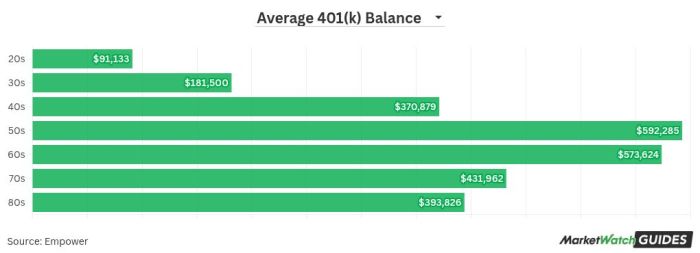
When it comes to retirement savings, demographics play a significant role in shaping 401k plan participation and balances. The age-old question is, “What factors influence average 401k balances by age?” To answer this question, let’s break down the key demographics, plan design features, and investment options that impact 401k balances.
Demographics: Age, Income, and Education Level
Demographics such as age, income, and education level significantly influence 401k plan participation and balances. Research shows that individuals aged 50-64 have higher 401k balances compared to those in younger age groups. This is because older workers have more time to accumulate savings and may have higher incomes, which enable them to contribute more to their 401k plans.
- Age: Workers aged 50-64 have higher 401k balances (approximately $143,500) compared to those in younger age groups.
- Income: Higher-income earners tend to contribute more to their 401k plans, resulting in larger balances.
- Education Level: Workers with higher education levels tend to participate more in 401k plans and have larger balances.
Employer Matching Contributions and Vesting Schedules
Employer matching contributions and vesting schedules can significantly impact 401k balances. A study by Fidelity found that workers who contribute to their 401k plans and receive employer matching contributions have higher balances compared to those who do not participate in the plan. Additionally, the vesting schedule can affect how quickly employees can own their employer-matched contributions. A faster vesting schedule can encourage workers to participate in their employer’s retirement plan.
- Employer Matching Contributions: Workers who contribute to their 401k plans and receive employer matching contributions have higher balances (approximately $125,000) compared to those who do not participate in the plan.
- Vesting Schedule: A faster vesting schedule can encourage workers to participate in their employer’s retirement plan and increase their 401k balances.
Investment Options: Stock and Bond Funds
Investment options such as stock and bond funds can significantly impact 401k balances over time. Research shows that workers who invest in a mix of stocks and bonds tend to have higher 401k balances compared to those who invest only in one asset class. This is because diversification helps spread risk and can lead to higher returns over the long term.
- Stock Funds: Workers who invest in stock funds tend to have higher 401k balances (approximately $135,000) compared to those who invest only in bond funds.
- Bond Funds: Workers who invest in bond funds tend to have lower 401k balances (approximately $90,000) compared to those who invest in a mix of stocks and bonds.
Patterns and Trends in 401k Plan Participation and Balances
Analysis of 401k plan participation and balances among different age groups reveals some interesting patterns and trends. For example, workers aged 60-64 tend to have higher 401k balances compared to those in younger age groups. This may be due to the fact that older workers have more time to accumulate savings and may have higher incomes, which enable them to contribute more to their 401k plans.
- Higher Balances: Workers aged 60-64 tend to have higher 401k balances (approximately $185,000) compared to those in younger age groups.
- Lower Participation: Workers in younger age groups tend to have lower 401k plan participation rates compared to older workers.
Future Projections of Average 401k Balances by Age

As we look to the future, it’s exciting to think about how our 401k balances might grow and change. But what can we expect, and how can we make the most of our savings? Let’s take a closer look at the trends and predictions that are shaping the world of 401k investing.
Stock Market Performance and Interest Rates: What’s on the Horizon?
The past few years have seen significant changes in the stock market, with some areas performing well while others lag behind. As we move forward, it’s likely that interest rates will play a key role in the growth of our 401k balances. According to recent forecasts, interest rates are expected to remain relatively stable in the short term, but could see a rise in the longer term.
This means that investors who focus on longer-term growth strategies may see their portfolios benefit from increased earning potential.
“Investors who focus on longer-term growth strategies may see their portfolios benefit from increased earning potential.”
When it comes to the stock market, experts predict that the next decade will see continued growth in emerging markets, such as those in Asia and Latin America. These regions are expected to drive global economic expansion, making them an attractive investment opportunity for those looking to diversify their portfolios.
Fiduciary Standards and 401k Plan Design: How Changes Will Affect You
Regulatory changes can have a significant impact on the world of 401k investing. One area that has seen significant updates in recent years is the fiduciary standard, which requires advisors to act in the best interest of their clients. This shift has led to a focus on fee-based compensation, which can benefit investors by reducing costs and increasing transparency.As regulatory changes continue to shape the 401k landscape, plan design and participation are likely to play a key role.
With the rise of fee-based compensation, investors may see more flexible plan options and improved investment choices.
Maximizing Your 401k Savings: Tips and Strategies for Success
Now that we’ve looked at the trends and predictions, what can you do to make the most of your 401k savings? Here are a few key strategies to consider:
- Contribute consistently: Regular contributions, even small ones, can add up over time. Consider setting up an automatic transfer from your paycheck to your 401k account.
- Take advantage of employer matching: If your employer offers matching contributions, be sure to contribute enough to maximize the match. This is essentially free money that can boost your savings.
- Choose low-cost investments: Fees can eat into your returns over time, so choose low-cost index funds or ETFs when possible.
- Consider a catch-up contribution: If you’re 50 or older, consider making catch-up contributions to your 401k account. This can help you maximize your savings and stay on track for retirement.
By implementing these strategies and staying informed about the latest trends and predictions, you can work towards achieving your retirement goals and building a secure financial future.
Final Thoughts: Average 401k Balance By Age Fidelity
As we’ve explored the intricacies of average 401k balance by age fidelity, one thing is clear – the future of retirement savings is brighter than ever. By understanding the factors that influence our nest eggs and leveraging innovative 401k plan design features, we can ensure a financially secure tomorrow. Remember, the key to a successful retirement lies in starting early, being consistent, and staying informed.
So, take control of your financial destiny, and let’s embark on this journey together towards a brighter tomorrow.
FAQ Insights
Q: What is the average 401k balance for Fidelity investors by age group?
A: The average 401k balance for Fidelity investors varies by age group, but according to their latest data, the average balance among participants in their 20s is around $24,000, while those in their 50s have an average balance of around $125,000.
Q: How does Fidelity’s 401k plan design contribute to higher average 401k balances?
A: Fidelity’s 401k plan design features, such as automatic enrollment and default investment options, have contributed to higher average 401k balances. Additionally, their innovative approach to participant education and investment offerings has helped participants make informed decisions about their retirement savings.
Q: What are the most significant factors influencing average 401k balances by age?
A: The most significant factors influencing average 401k balances by age include demographics, employer matching contributions, vesting schedules, and investment options. Understanding these factors is crucial for making informed decisions about retirement savings.
